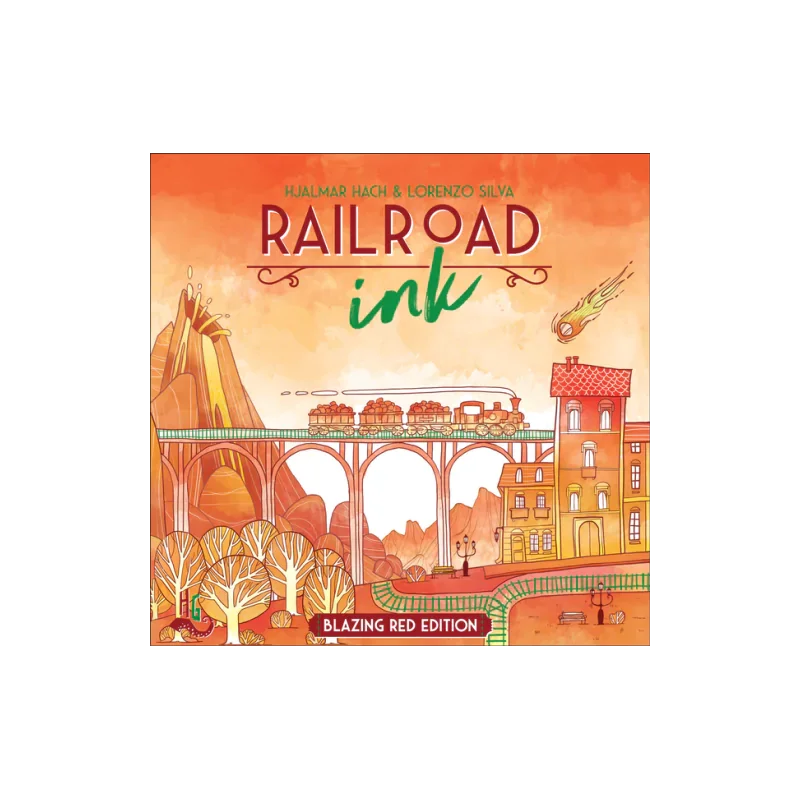
⭐ 10/10
Players: 1–6 people
Play Time: approx. 20–30 min
Difficulty: Junior-friendly (easy to learn!) Game Type: Logic, Family, Strategy Mechanics: Dice Rolling, Network Building, Route Management
Railroad Ink: Blazing Red Edition is my number one travel companion. This game is so satisfyingly frustrating that you just can't stop—it’s the quintessence of the "just one more game" syndrome, which I love playing in hotels after a long day on the road.
🎯 What is this game about?
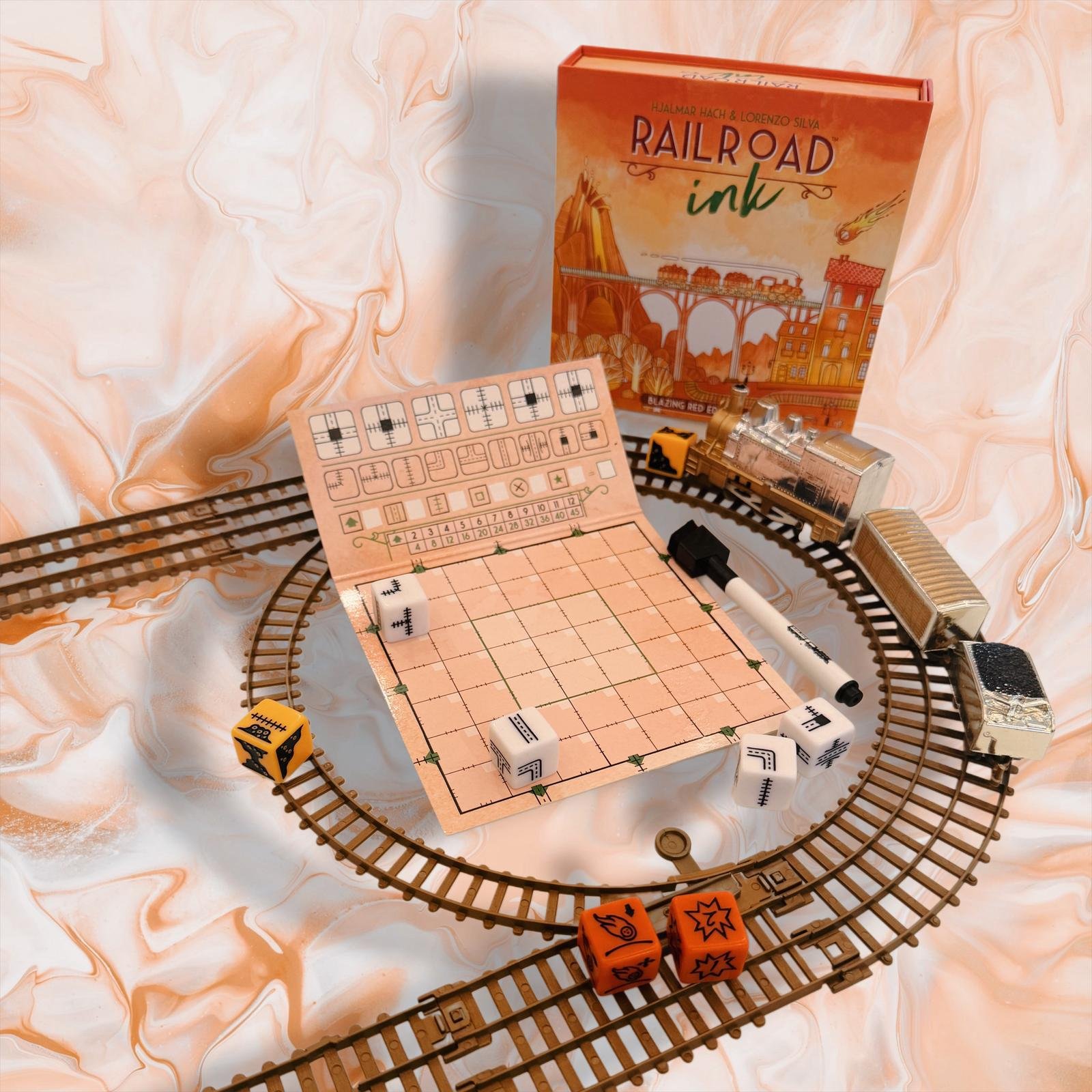
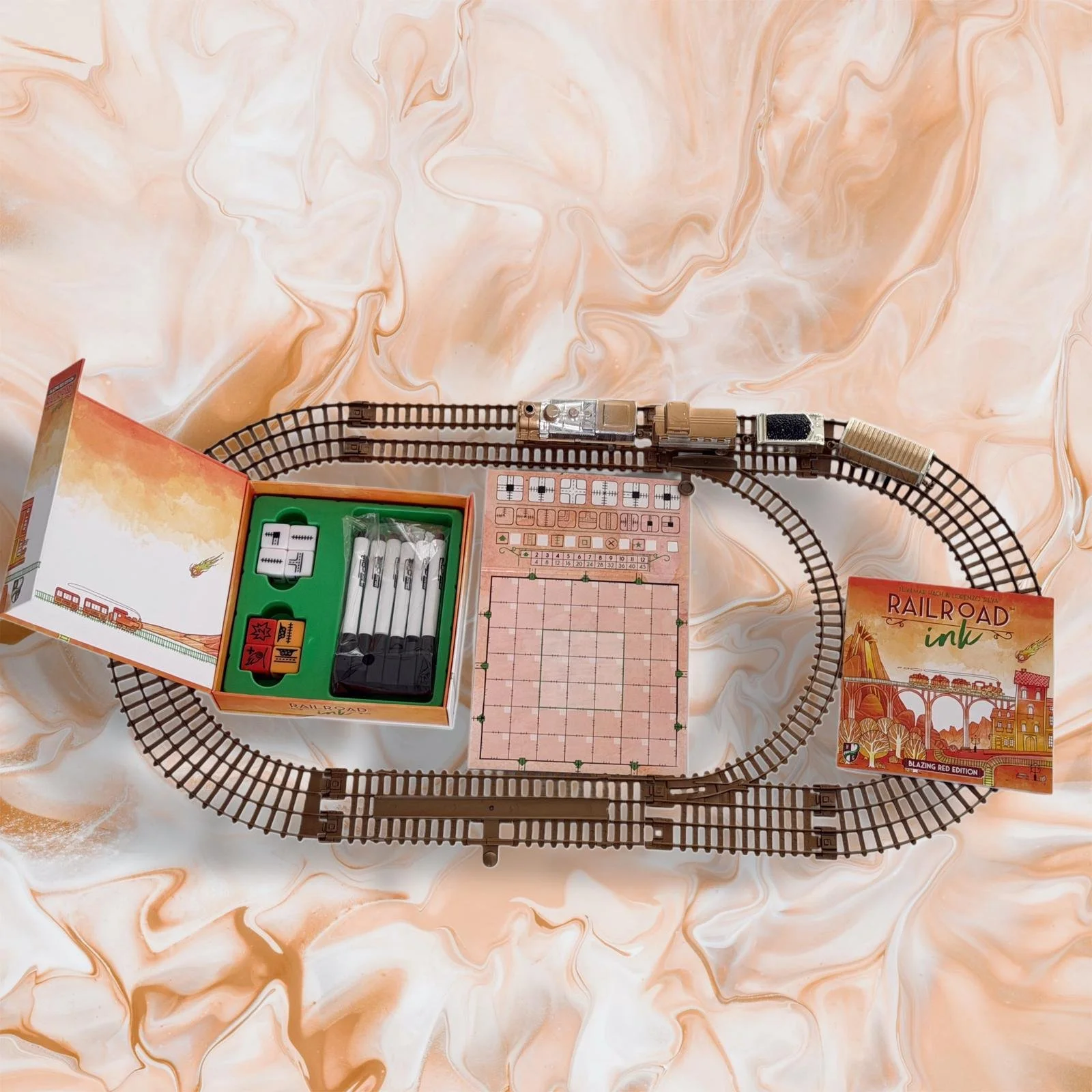
It’s a "roll & write" game. All players use the same results from four Route dice to design their own transportation network on a dry-erase board. The Blazing Red edition adds spicy expansions: Lava and Meteor dice
🎯 Goal of the Game
The main goal is to connect as many Exits as possible located around the edges of your board. The more Exits connected to the same network, the more points you score at the end.
🛡️ How a Turn Works
A standard game lasts 7 rounds. Each round proceeds as follows:
Rolling Dice: At the start of the round, the 4 Route dice are rolled.
Drawing: All players simultaneously draw the rolled routes on their boards.
Building Rules: Each new route must connect to an Exit or a pre-existing oute. You cannot connect a railway directly to a highway without a Station. Overpasses allow routes to cross without connecting.
Special Routes: Once per round, you can use one of the 6 special routes shown at the top of your board, but you are limited to 3 special routes per game.
🌋 Expansions: Lava and Meteors (6 rounds!)
When you add expansion dice, the game is shortened to 6 rounds.
Lava: You must draw at least one lava die each round. You score points for your largest lava lake (1 pt per space) and a 5-point bonus for every lake that is completely enclosed.Meteors: Meteors destroy your routes. If a meteor hits a space with a route, you must erase it and draw a crater. However, you gain 2 bonus points for every route lead into a crater.
🏆 How to win?
The player with the most points after adding networks and bonuses (and subtracting penalties) wins. To maximize your score, focus on:
Networks: The bigger the network, the higher the value (e.g., 12 exits are worth 45 pts).
Central Spaces: You get 1 bonus point for every space in the central 3x3 grid that you draw on.
Errors: Avoid leaving "hanging" routes; every open end that doesn't connect to anything or the board edge is -1 point. If there's a tie, the player with the fewest errors wins.
🌿 Why does this game work so well?
The small board and dry-erase marker make it ultra-compact. The game is incredibly replayable because every session offers different rolls and unique puzzles. Nothing is as exciting as calculating scores at the end and seeing how everyone built something completely different from the same dice!
💀 Why might someone not like it?
The game punishes errors harshly—every open route end costs you. If you dislike randomness ruining your carefully planned connections (like needing a straight line but getting only curves), you might feel a bit of "rail-rage".
☕ My Impressions
Building these routes is a nostalgic reminder of the past PKP (Polish State Railways) infrastructure. It feels like managing real-world rail; sometimes you have to leave passengers "in the middle of nowhere" because the dice luck just wasn't there hahahaha. It’s a perfect mix of planning and hoping for a lucky roll—much like waiting for a train that may or may not arrive.
I am now eagerly waiting for Railroad Ink Challenge: Lush Green Edition—I love the color green, and I’m sure that aesthetic will be right up my alley!
