⭐ 2/10
Player Count: 1–4 players
Playtime: Approx. 30 min (Fast-paced action!)
Difficulty: Very low (Junior-friendly)
Genre: Economic, Strategy, Family
Mechanics: Worker Placement, Engine Building
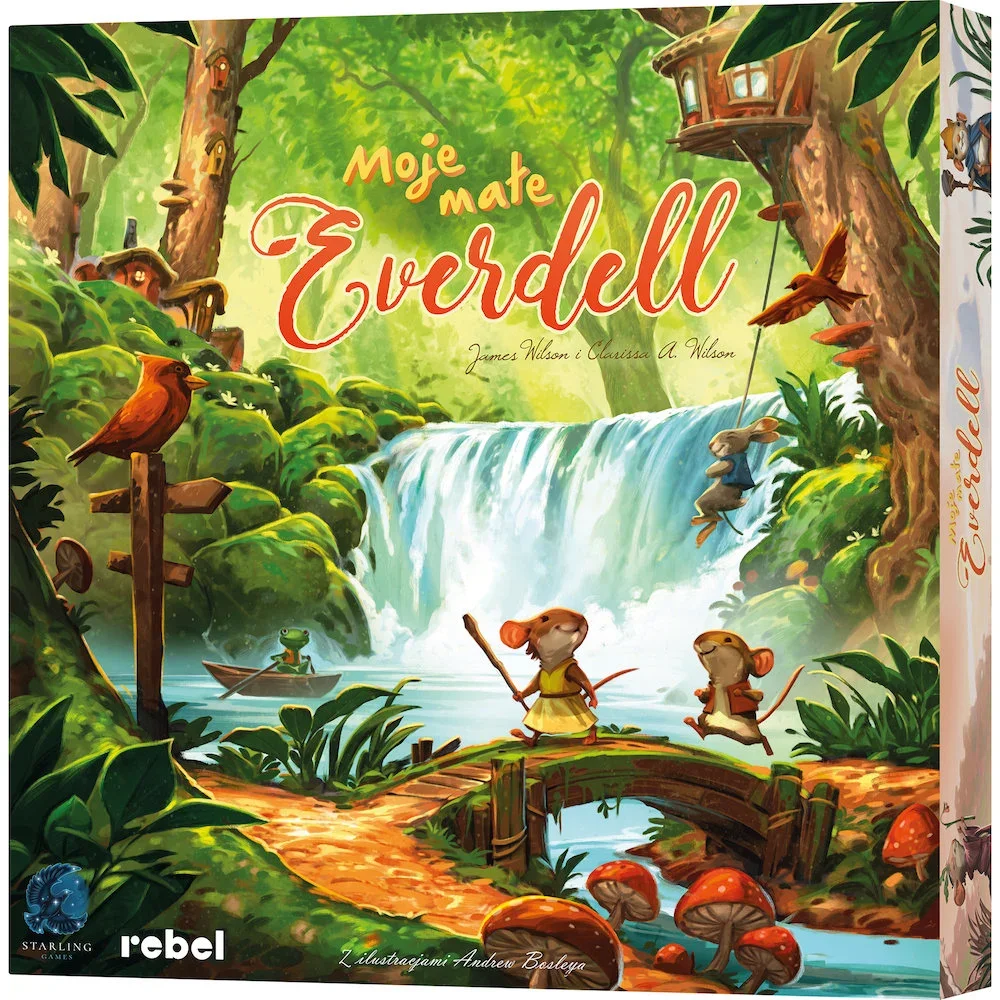
My Lil' Everdell is a simplified, family-friendly version of Everdell. We play as kids building a fort, pretending it's a castle. Instead of four seasons and an elaborate card engine — we get 4 quick rounds with resource dice, a 54-card deck, and 3 friend meeples (butterflies, foxes, mice, or lizards).
I gave the big Everdell a 2/10 — it felt more like managing a tiny, extremely cute company than a relaxing game. So I thought — maybe the "little" version will be what I need to fall in love with this world?
Spoiler: nope.
🛡️ Mechanics — what's actually here?
Round structure (5 steps):
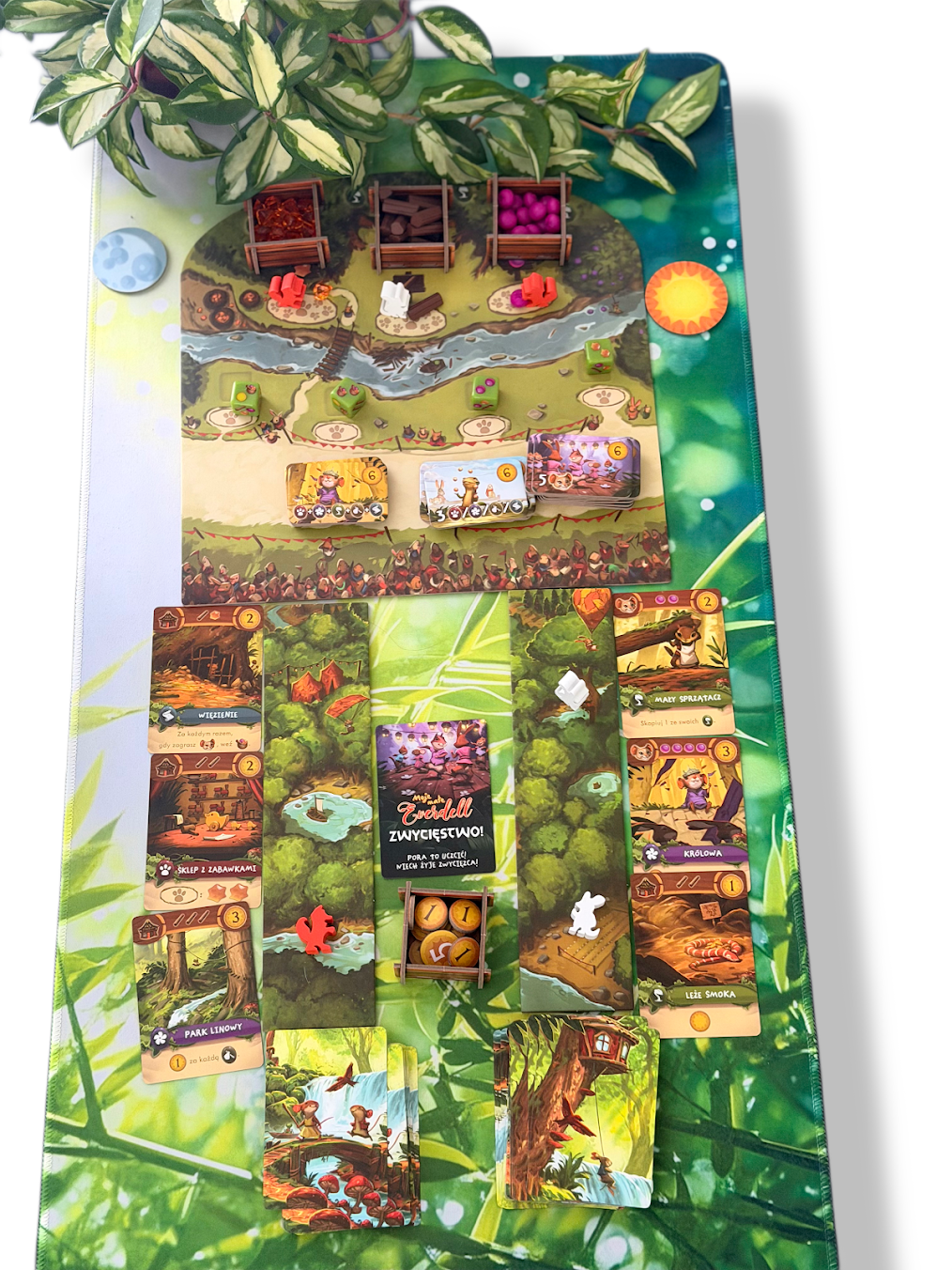
Roll the dice — the first player rolls the resource dice (one die per player) and places them on the board's dice spaces. This determines which resources are available this round.
Gather goodies — activate your green cards (production). Nothing happens here in the first round, unless you're playing with the beginner boost (Captain/Fort cards).
Play turns — 3 turns per player. Each turn you place 1 friend meeple on a space (3 shared spaces, dice spaces, red card spaces), collect resources, and optionally buy 1 card from the open market (8 cards). Check parade conditions.
Return home — meeples go back to your house boards.
Pass the sun token — new first player, advance the moon token.
Card system (5 colours):
🟢 Green — production, activate every round (engine building lite)
🔵 Blue — triggers, activate when playing cards/earning parades (cost discounts)
🟤 Brown — one-time, activate when played
🔴 Red — have their own worker placement space, yours only
🟣 Purple — end-game scoring (points for other cards/parades)
Parades (4 types):
Point tokens (3–6 pts) for meeting conditions: 5 creatures, 5 constructions, 1 of each colour symbol, 3 cards of the same colour (not green). Decreasing value — first come, first served.
Solo mode:
You play against Prince Periwinkle or Princess Coltsfoot. Your opponent plays cards for free (!) based on a d8 roll, blocking dice spaces (Periwinkle) or taking cards from the market (Coltsfoot). They end up with 12 cards vs your 12. Additional challenges increase difficulty.
🌿 Why it might work?
It's ideal for kids. Rules are simple, and the handicap system (starting bonus + Captain and Fort cards) balances the odds between a 6-year-old and a parent. Smart design choice.
Production quality matches the original. Wooden resource crates (self-assembly!), gorgeous illustrations by Andrew Bosley, adorable meeples. Physically, this game is a delight.
Card colours = readability. The 5-colour system is intuitive and creates a minimal engine — green produces, blue discounts, purple rewards at the end. Trivial for experienced players, but for a child — a perfect first contact with engine building.
Parades give purpose. Without them, the game would be completely aimless. The race for 6-point tokens gives some reason for player interaction.
💀 Why it doesn't work? (My impressions)
Dice steal your agency. At the start of each round, the dice roll determines available resources. Sometimes you just don't roll what you need. In an adult game, you'd have a plan B. Here there's no plan B — because there's no room for one in 3 turns.
Decisions make themselves. 3 turns per round, 4 rounds = 12 placement decisions in the entire game. Plus 12 optional card purchases. From a market of 8 cards, usually 1–2 make sense with your resources. This isn't a decision space — it's a checklist.
No interaction. The only interaction is blocking dice spaces (1 meeple per space) and the parade race. Shared spaces don't block. No drafting, no bargaining, no sabotage. Everyone plays their own game.
Engine building is an illusion. Green cards produce — sure. But with 4 rounds, you get maybe 2 rounds of actual "production" from green cards played in rounds 1–2. That's not an engine — it's a cigarette lighter.
A Good Year (my rating: 20/10) 😄 proved to me that a game with berries, wooden resources, and a cozy atmosphere CAN be deep and exciting. It has the same ingredients — warmth, wood, seasons — but there, every decision carries weight. Here it doesn't.
🎯 Who is it for?
✅ Parents looking for a first worker placement game with their 5–7 year old
✅ Fans of the Everdell universe who want to introduce little ones to the world
✅ Anyone looking for a pretty, stress-free 30-minute game
✅ Everdell collectors (because the production is beautiful)
❌ Adult gamers looking for any kind of challenge
❌ Anyone who was bored by "big" Everdell — this will be even worse
❌ Solo players (Periwinkle/Coltsfoot is a random automaton, not an opponent)
❌ Anyone who likes engine building (this engine doesn't even start)
✨🧀 Cheesy Joke Corner
My Lil' Everdell is like ordering an espresso and getting a milk with foam art shaped like a teddy bear. Pretty? Sure. But where's the coffee? ☕🐻
☕ Verdict
I love those berries, so I wanted to give the Everdell world a chance. I thought — maybe I'll try something lighter to start? Unfortunately, this game is just boring to me. I don't feel like I'm in A Good Year, I don't feel like anything is happening. I gave it away to someone else.
If you love the Everdell universe and want to introduce a 6-year-old to it — bullseye. But if you're looking for a strategic challenge and the original bored you, My Lil' Everdell will convince you even less.
The game does one thing well: it's a gateway into the hobby for little ones. But for me, it's like reading a picture book for preschoolers — the illustrations are beautiful, but the story ends before I even get comfortable.
🎯 Rating: 2/10
Beautiful. Polished. Not for me. A gateway game for toddlers that offers an adult gamer about as much as a nap by the fireplace — warm, but zero excitement.
